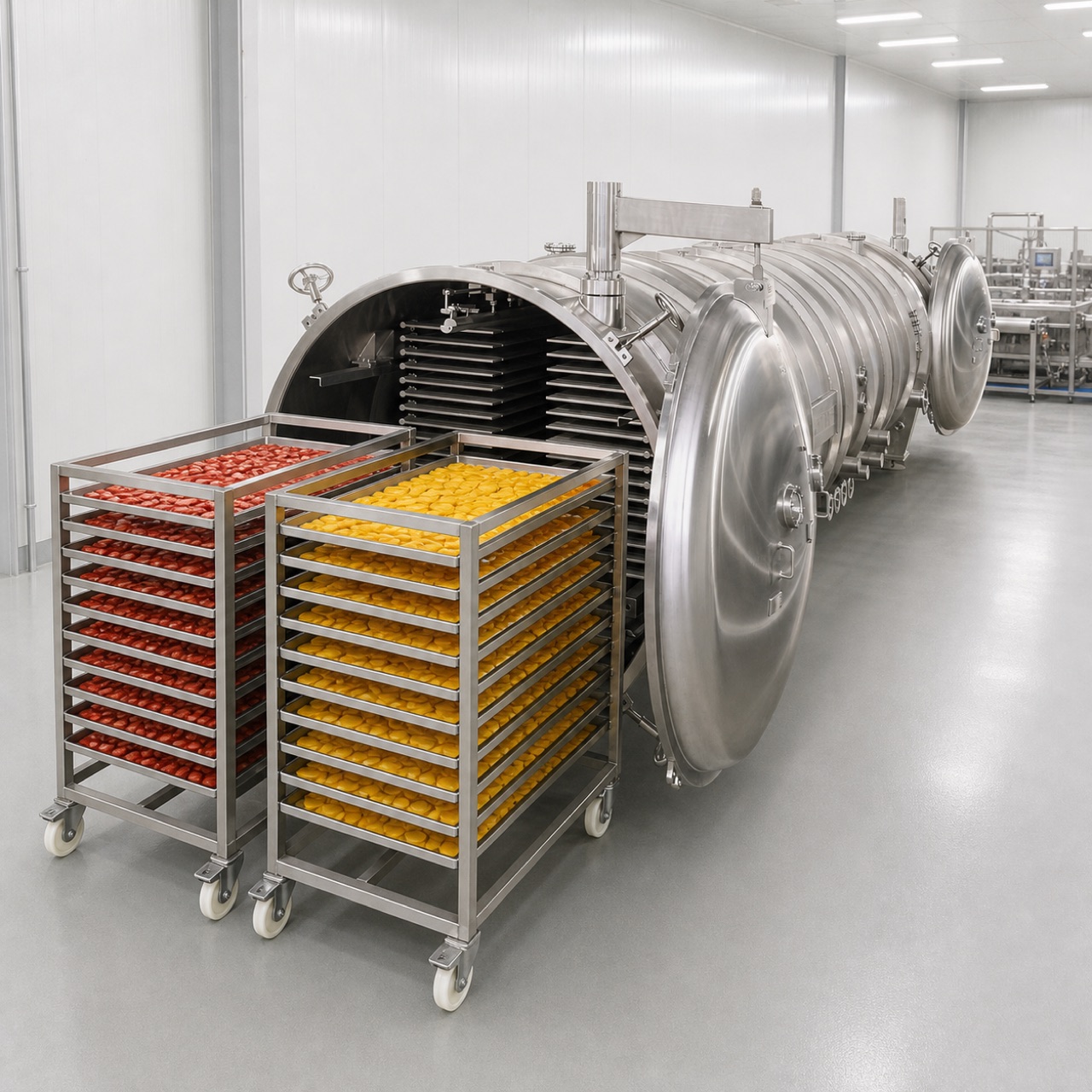
A large food freeze dryer can meet its technical specification and still underperform as a factory asset when frozen product, carts, utilities or packaging cannot keep pace. This guide starts at the room boundary and follows one batch from prepared food to sealed product. It complements, rather than repeats, a basic capacity comparison.
Equipment and application views
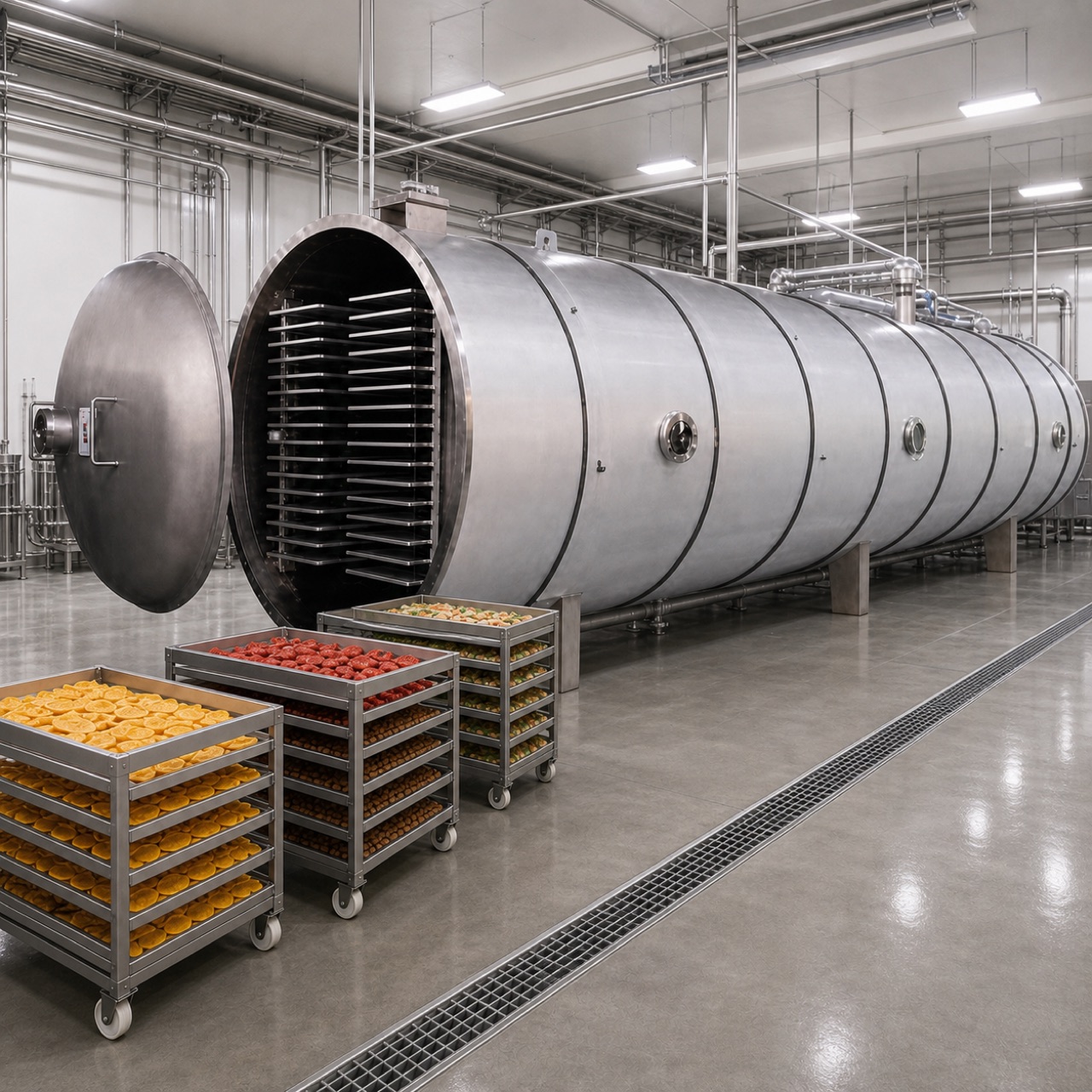
Convert the sales target into a batch rhythm
Work backward from saleable finished product. Record the incoming solids or measured fresh-to-finished yield, package size, weekly demand and seasonal peak. Then add the real turnaround steps: preparation, pre-freezing, loading, evacuation, drying, unloading, defrost, cleaning and packaging.
A dryer described as 500 or 1,000 kg per batch cannot automatically deliver that weight every calendar day. Product thickness, removable water, endpoint, changeover and packaging determine how often a full load can actually leave the line.
- Prepared kilograms per batch and per day
- Kilograms and depth per tray
- Expected complete turnaround time
- Packaging output per hour
Place pre-freezing and frozen buffer before the dryer
Compare in-chamber freezing with a separate blast freezer or cold room. Separate pre-freezing can keep a new load ready while the FFD dries the current batch, but it also requires enough carts, frozen buffer and door capacity.
Draw the route from the preparation room to the freezer and then to the FFD. Include loaded cart dimensions, turning radius, thresholds, rail height and the maximum permitted transfer time. Air temperature is not proof that the center of every piece is frozen.
Reserve a straight, maintainable loading path
Confirm chamber door swing, cart travel, clean-cart staging and the return route after unloading. The floor, rails and cold-room interface should be checked with the actual loaded cart rather than a simplified rectangle on the layout.
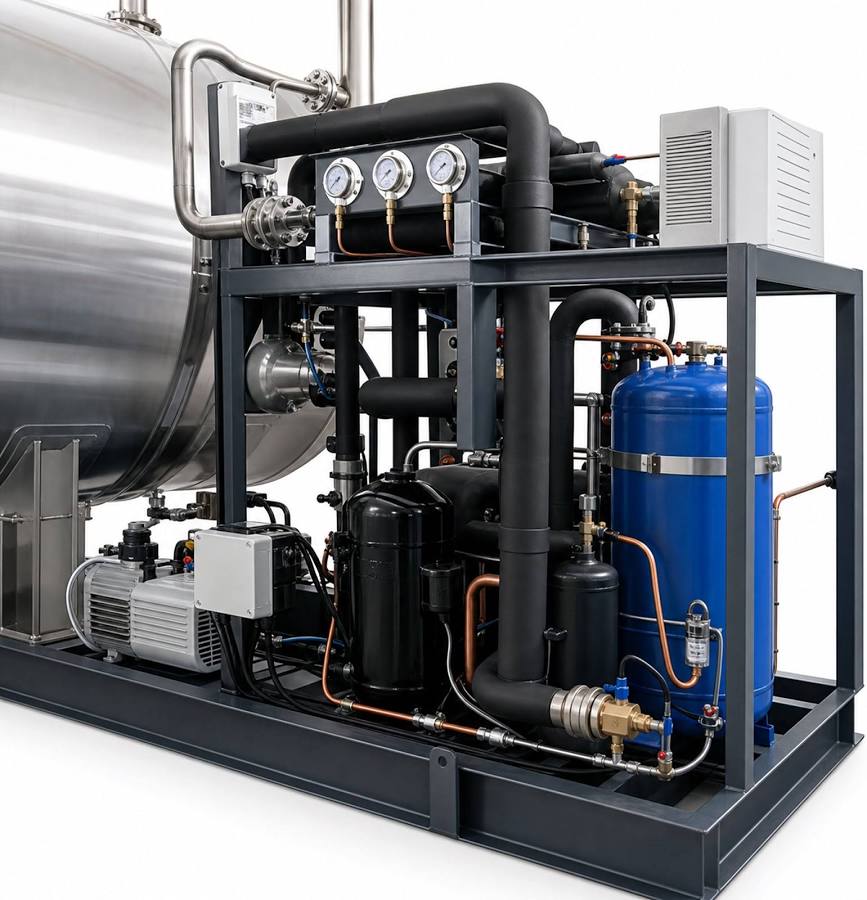
Keep service sides open for compressors, pumps, valves, condensers, control cabinets and the largest removable component. A compact drawing that blocks maintenance access transfers cost into every future repair.
Publish one utility schedule for the complete line
For each connection, state medium, condition, peak demand, normal demand, allowable variation, connection size and responsibility. Depending on configuration, the schedule can include power, cooling water, drainage, defrost, ventilation, compressed air, clean gas and pump exhaust.
Where several dryers or freezers share a plant room, calculate coincident peak loads. Also review heat rejection, ambient temperature and ventilation at the most demanding season, not only the nominal indoor condition.
Size unloading and packaging for one full discharge
Freeze-dried food can regain moisture while operators prepare bags or clear a sealer. Stage barrier material, labels, absorbers or gas where validated and enough operators before the chamber is opened.
Define humidity control, sampling, unload-to-seal time and seal verification. The packaging room should receive the complete discharge without forcing open trays to queue in an uncontrolled area.
Use the layout review to choose an ADT model
ADT-500I through ADT-2500I represent approximately 50-250 m2 shelf-area platforms. Select the first candidate from measured product loading and water removal, then test the candidate against the room, utilities, cart count and daily schedule.
The approved quotation should attach a general-arrangement drawing and utility schedule. Marketing capacity remains a planning reference until the product and complete production rhythm are reviewed.
Frequently asked questions
How much space does an industrial food freeze dryer line need?
There is no universal footprint. The approved chamber, service equipment, doors, cart turning, pre-freezing, packaging and maintenance route must be placed on the actual building drawing.
Can a separate blast freezer increase daily output?
It can improve dryer utilization when product, cart and transfer controls are suitable, but the gain depends on frozen buffer, loading time, cycle duration, defrost and packaging.
Why should packaging be designed with the freeze dryer?
The complete batch becomes moisture-sensitive at unloading. Packaging must accept and seal that discharge promptly under conditions suitable for the product.
This page provides general engineering and operating context. The model-specific manual, approved site procedure, technical agreement and product validation take priority.