
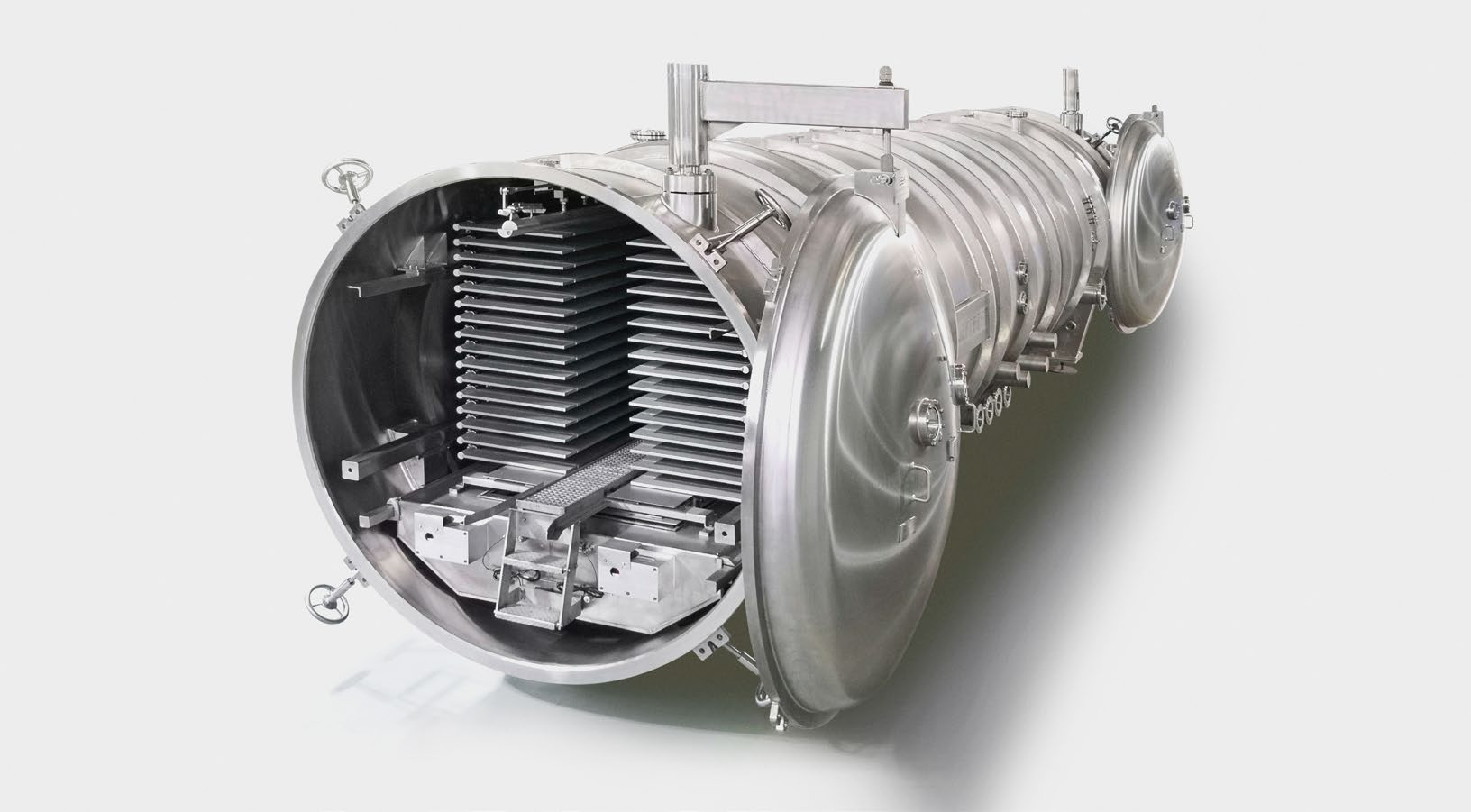
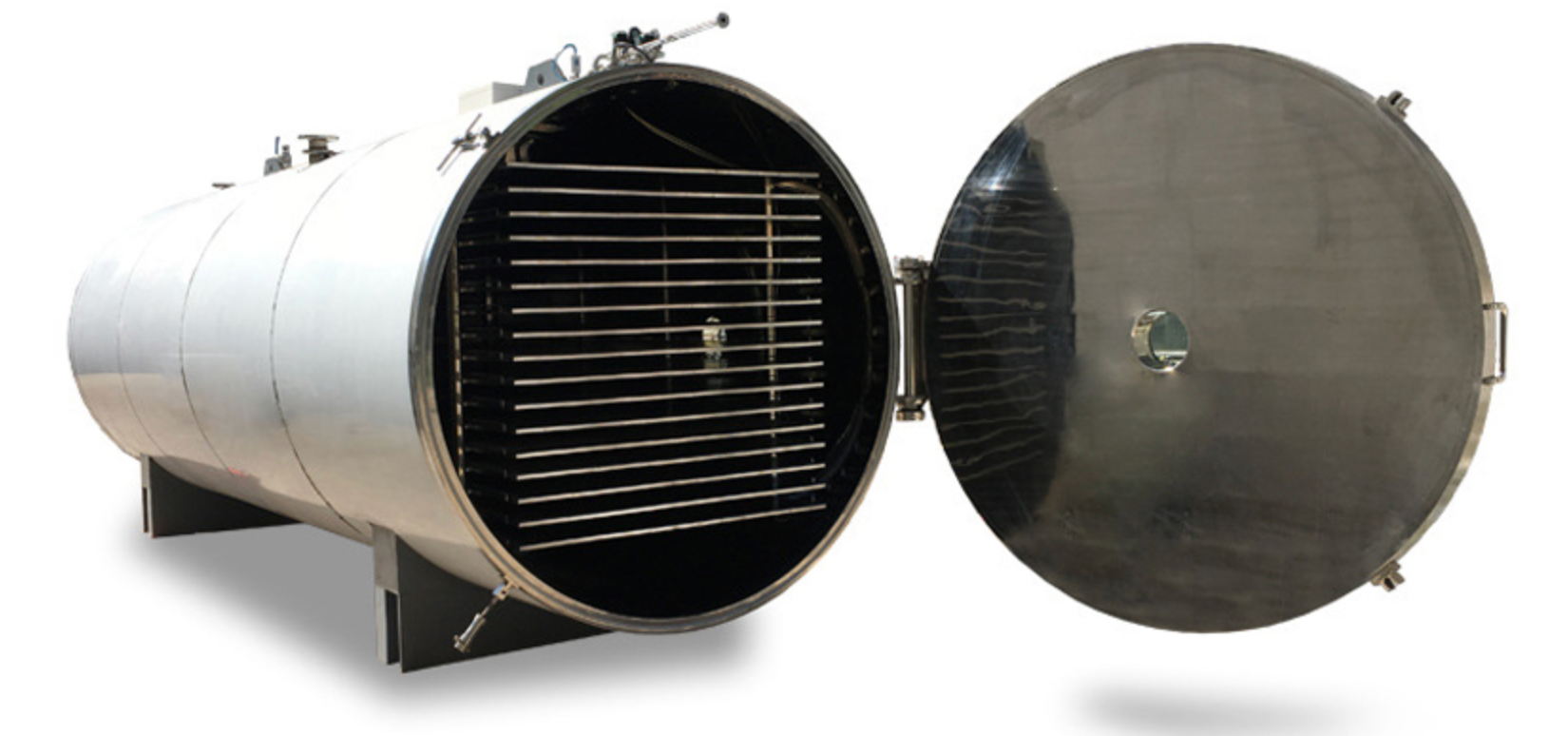
A large industrial food freeze dryer should be reviewed as plant equipment, not selected from a single catalog capacity. This 20-second SJ-FFD-100 product visual overview helps a project team discuss chamber access, tray and cart movement, refrigeration and vacuum modules, utilities and service space. It is a visual planning aid, not a customer-site video, factory acceptance report or guaranteed performance record.
Equipment and application views
Start with water removal, not the model number
The SJ-FFD-100 reference platform is associated with approximately 100 m2 of usable shelf area and an approximately 1,000 kg/batch prepared fresh-load reference on the manufacturer page. Those figures begin a comparison; they do not guarantee a finished-product weight or one cycle for every food.
Send initial moisture or solids, target moisture or water activity, product dimensions or fill depth, kilograms per tray and the planned number of trays. The expected water to remove and the peak sublimation load are more useful to condenser and refrigeration sizing than the food name alone.
Review loading and material flow before fixing the room
Map preparation, external pre-freezing where used, frozen-product staging, cart or tray loading, chamber access, unloading and low-humidity packaging. Confirm door swing, cart turning radius, floor transitions and the time frozen product can remain outside controlled storage.
The dry product can absorb ambient moisture quickly. Packaging capacity and humidity control therefore belong in the same layout review as the freeze dryer. A nominally larger dryer does not improve saleable output if unloading and sealing become the bottleneck.
Reserve utilities and service access
Ask for the project electrical supply, peak and expected running loads, cooling conditions, drainage and defrost route, ambient design temperature, ventilation, compressed air where configured, network interfaces and any external pre-freezer loads.
The approved general-arrangement drawing should show the largest shipping modules, rigging path, foundations or floor loads, service clearances and future component-removal paths. Equipment placed against a wall can make ordinary compressor, pump or valve work unnecessarily difficult.
Treat installed power as an electrical-planning value
Installed power is not average energy consumption. Compressors stage, heating modulates and vacuum, defrost and auxiliaries operate at different points in the batch. A fair comparison uses estimated kWh per batch and kWh per kilogram of water removed, with the calculation boundary stated.
Include external pre-freezing, cooling-water systems, room HVAC, cleaning and packaging when comparing the complete line. Product recipe, ambient conditions and cycle utilization can materially change the result.
Turn manufacturer experience into project documents
The SJ platform is supported by a China-based manufacturing and engineering team with about 15 years of freeze-drying equipment experience. That experience should appear in a traceable URS response, loading basis, utility schedule, component list, general-arrangement drawing, FAT scope, installation responsibility matrix and operator handover plan.
A polished video is useful for orientation, but it does not replace those documents. Final performance belongs in the approved technical agreement and the accepted project test basis.
Frequently asked questions
Is FFD-100 a guaranteed 1,000 kg finished-product machine?
No. Approximately 1,000 kg/batch is a prepared fresh-load reference. Finished weight and practical load depend on solids, water removal, product geometry, tray loading, cycle and endpoint.
Does the video prove cycle time or energy consumption?
No. It is a product visual overview. Cycle time and energy require an agreed product, loading, utility and test basis.
What is the most useful first document for an industrial FFD RFQ?
A one-page product and site worksheet containing fresh load, water or solids, geometry, tray loading, pre-freezing, endpoint, daily schedule, packaging and utilities is more useful than a model name alone.
This page provides general engineering and operating context. The model-specific manual, approved site procedure, technical agreement and product validation take priority.